
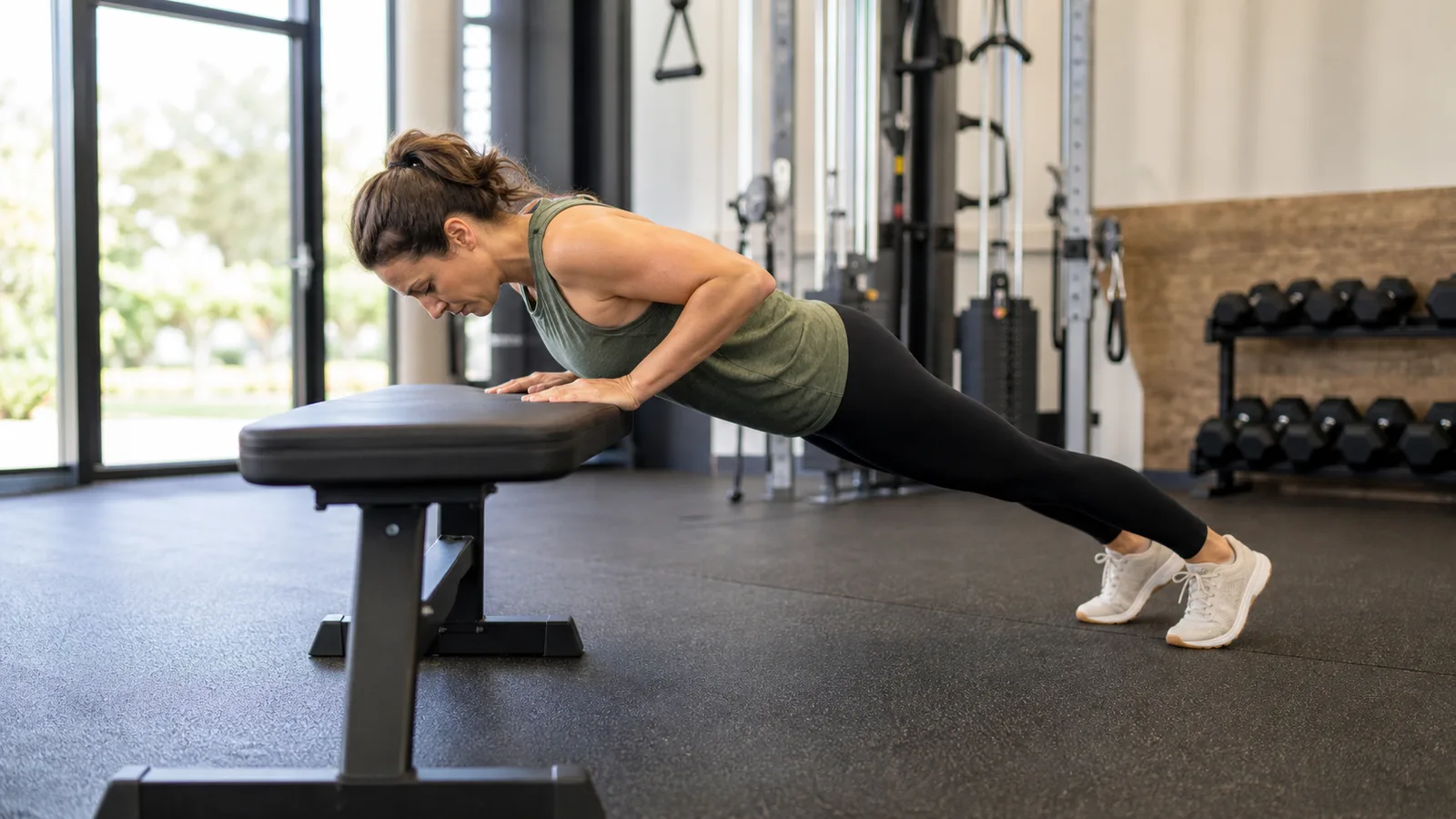
You do not need dips to train your triceps. Dips combine elbow extension with a deep shoulder position that some people tolerate well and others do not. A useful alternative matches the job you want—stronger pressing, triceps muscle growth, or a no-equipment arm exercise—without reproducing the same discomfort.
The best dip alternative depends on why you are switching
If dips hurt, do not force them or assume every substitute is automatically safe. Choose a movement that feels comfortable through the full repetition, and get persistent shoulder or elbow pain assessed by a qualified professional.
For muscle growth, combine at least one press with one direct elbow-extension exercise. For general strength, a close-grip push-up or close-grip bench press may be enough.
10 effective triceps dip alternatives
Use the table to match the exercise to your equipment and training level. Start with two sets and stop while you can still control the lowering phase.
| Exercise | Equipment | Why choose it |
|---|---|---|
| Close-grip wall push-up | Wall | Gentle beginner pressing angle |
| Close-grip incline push-up | Bench or counter | Easy to scale by changing height |
| Close-grip floor push-up | None | Full-body home pressing |
| Diamond push-up | None | Harder bodyweight option |
| Dumbbell floor press | Dumbbells | Floor limits deep shoulder extension |
| Neutral-grip dumbbell press | Dumbbells and bench | Comfortable grip for many lifters |
| Dumbbell overhead extension | One dumbbell | Trains triceps in an overhead position |
| Close-grip bench press | Barbell and bench | Loadable compound press |
| Cable pressdown | Cable stack | Stable direct triceps work |
| Assisted dip machine | Machine | Practice the pattern with less body weight |
How to program dip replacements
Place compound presses earlier in the workout and direct triceps exercises later. A simple session might use three sets of close-grip pressing for six to twelve repetitions, then two sets of pressdowns or overhead extensions for ten to fifteen.
Progress by adding repetitions until you reach the top of your range, then increase resistance slightly. If elbows become irritated, reduce total direct arm work, vary the grip, and avoid sudden jumps in volume.
Why bench dips are not always the easiest option
Bench dips look beginner-friendly because the feet remain on the floor, but they still place the upper arm behind the torso and can encourage a deep bottom position. Elevating the feet may add difficulty without improving control.
An incline close-grip push-up is often easier to scale: raise the hands to reduce load, keep the body straight, and lower only as far as the shoulders remain comfortable.
Muscle effort and joint pain are different signals. Stop a movement that causes sharp, catching, or increasing pain and choose a comfortable alternative.
A dip-free upper-body workout
Pair triceps training with both horizontal pulling and vertical pulling so the session is not built around pressing alone. Rest long enough to keep the next set controlled.
| Exercise | Sets × reps | Option |
|---|---|---|
| Neutral-grip dumbbell press | 3 × 6–12 | Incline close-grip push-up |
| Seated cable row | 3 × 8–12 | Band row |
| Lat pulldown | 2 × 8–12 | Band pulldown |
| Cable pressdown | 2 × 10–15 | Overhead dumbbell extension |
| Lateral raise | 2 × 10–15 | Very light bottles |
Frequently asked questions
What is the best no-equipment alternative to dips?
A close-grip push-up is a strong choice because you can scale it from a wall, counter, bench, knees, or floor while keeping the elbows close to the torso.
Can push-ups replace triceps dips?
Yes for general pressing strength and triceps work, especially with a closer hand position. You can add an overhead extension or pressdown if you want more direct triceps volume.
This article provides general fitness information, not individual medical advice. Choose movements suitable for your ability and speak with a qualified professional when you have pain, an injury, or a health concern.
Sources
Jamie’s Fit uses authoritative health guidance to review general exercise recommendations.