
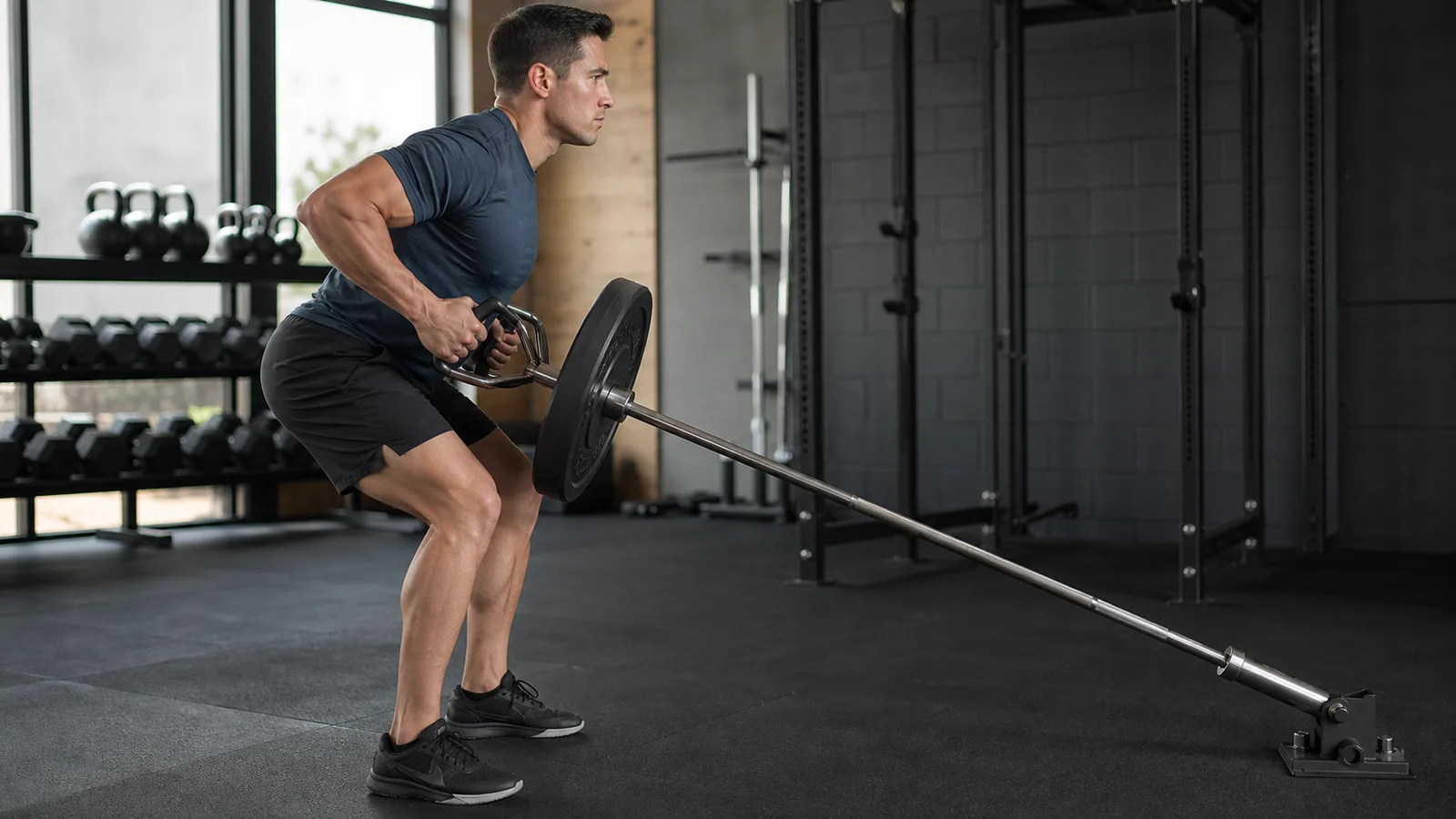
A landmine row uses a barbell anchored at one end, creating an angled path as you pull the loaded end toward your torso. You can hold the bar with both hands, use a close-grip handle for a T-bar row, or row one arm at a time. The setup supports heavy back training, but the anchor and plates must be secure before the first repetition.
How to set up a landmine row safely
Use a purpose-built landmine attachment fixed to a rack or heavy base. Do not wedge a bare bar into a wall unless the gym explicitly provides a protected setup for it. Load plates on the free sleeve and use a collar when the equipment design calls for one.
For a two-arm T-bar landmine row, straddle the bar and attach a compatible close-grip handle below the sleeve. Hinge at the hips, brace, and lift the loaded end to the start position with control. Keep feet clear of the plates.
An unanchored bar can slide or damage the floor and wall. Use equipment as the manufacturer and facility intend, and ask staff before improvising an attachment.
Two-arm landmine row form
Hold a steady hip hinge with the spine in a strong neutral position. Pull the handle toward the lower chest or upper abdomen, bringing the elbows back without aggressively shrugging. Pause, then straighten the arms under control.
The arc of the landmine becomes more vertical as the bar rises, so your distance from the sleeve changes the feel. Find a stance that lets the plates clear your body and the handle reach the torso without wrist strain.
| Element | Good position | Common mistake |
|---|---|---|
| Anchor | Purpose-built and stable | Loose bar end in an unprotected corner |
| Hinge | Torso angle held steady | Standing up with every rep |
| Pull | Handle to lower chest or upper abdomen | Shrugging toward the ears |
| Lowering | Arms extend under control | Dropping plates onto the floor |
One-arm landmine row variation
Stand beside the bar with the loaded sleeve near one hip. Hinge, hold the sleeve below the plates, and row toward the same-side hip while keeping the torso mostly square. A staggered stance can improve balance.
The one-arm version allows each side to work independently and can suit lifters who do not have a T-bar handle. Start very light; gripping the thick sleeve is more demanding than holding a standard dumbbell handle.
Muscles worked and programming
Landmine rows train the latissimus dorsi, trapezius, rhomboids, rear shoulders, and elbow flexors. The trunk, glutes, and hamstrings stabilize the hinged position. A close handle and elbows near the torso generally create a different emphasis from a wide-elbow row, but no row perfectly isolates one back muscle.
Use two to four sets of six to twelve repetitions. Add repetitions first, then a small plate. Remember that the effective load at the hands is not identical to the plates listed on the sleeve because the bar pivots at an angle; compare your own setup consistently instead of treating it like a free barbell total.
Landmine row alternatives
Choose a chest-supported row when the hip hinge or lower-back fatigue limits back training. A seated cable row offers easy load changes, while a one-arm dumbbell row needs less specialized setup.
- Chest-supported machine or dumbbell row
- Seated cable row with a neutral handle
- One-arm dumbbell row supported on a bench
- Resistance-band row for home training
- Wide-grip barbell row for a higher elbow path
Frequently asked questions
Are landmine rows the same as T-bar rows?
A landmine T-bar row is one type of T-bar row. Some dedicated T-bar machines use a chest pad or a different pivot and therefore feel different from a barbell landmine setup.
Why do I feel landmine rows in my lower back?
The lower back works to hold the hinge. Reduce the load, improve bracing, or choose a chest-supported row if trunk fatigue ends the set before your back muscles are challenged.
Can I do landmine rows without an attachment?
Only use a setup approved by the facility and equipment manufacturer. A purpose-built anchor is the safest choice; an unsecured bar can move and damage surfaces.
This article provides general fitness information, not individual medical advice. Choose movements suitable for your ability and speak with a qualified professional when you have pain, an injury, or a health concern.
Sources
Jamie’s Fit uses authoritative health guidance to review general exercise recommendations.