
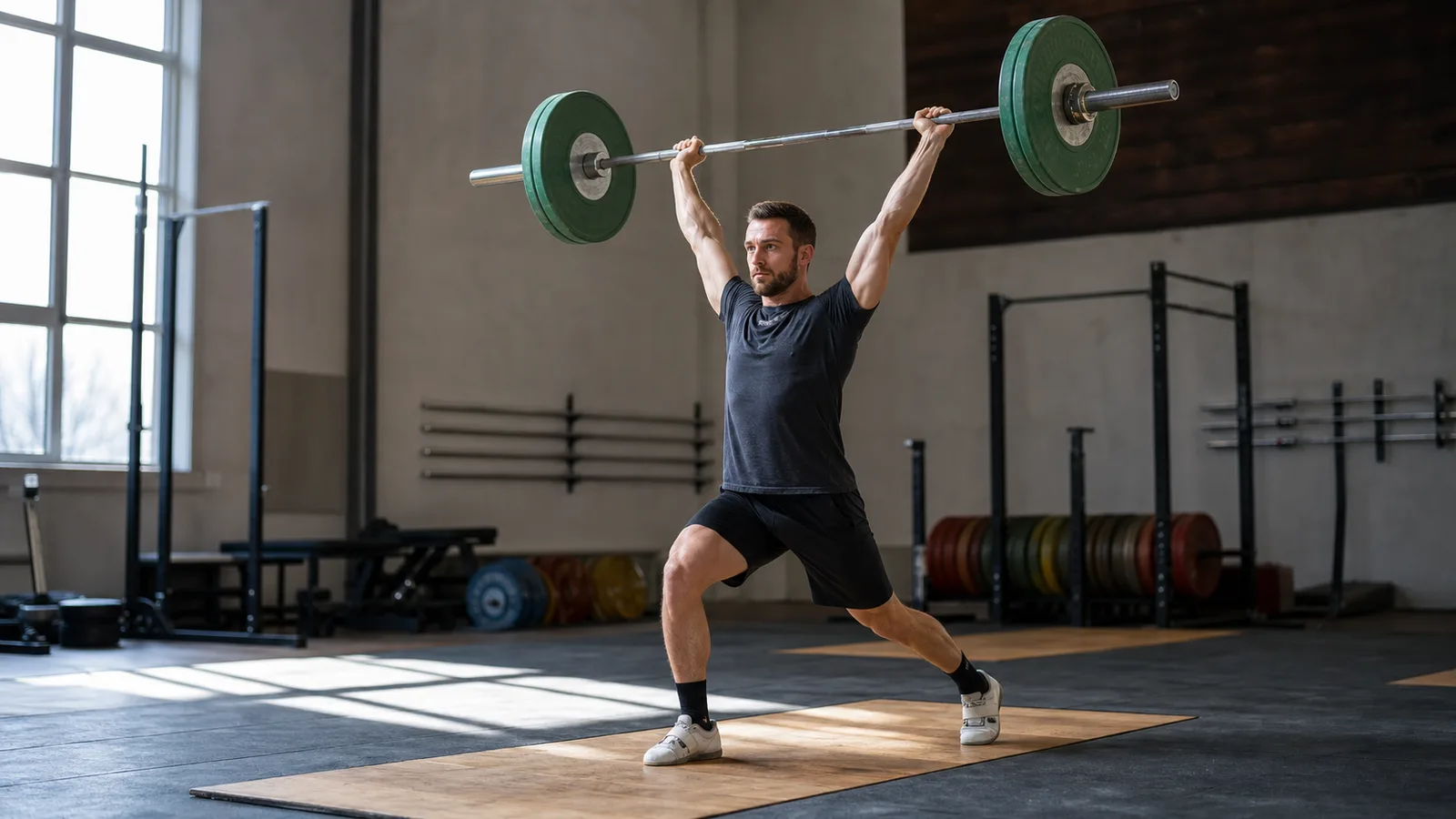
The clean and jerk is an Olympic weightlifting event that moves a barbell from the floor to the shoulders, then from the shoulders to a stable overhead position. “Cling and jerk” is a common misspelling of the same lift. The movement rewards speed, timing, mobility, and technique, so beginners should learn it with an empty bar, technique plates, and qualified coaching before pursuing heavy loads.
What happens during a clean and jerk?
USA Weightlifting defines the lift as two continuous parts. In the clean, the athlete pulls the bar from the floor and receives it on the shoulders. After standing and settling, the athlete uses the legs and arms to drive the bar overhead in the jerk.
Unlike a clean and press, the jerk includes a fast dip and leg drive plus a second bend of the knees to receive the bar. That lets trained weightlifters handle more weight than they could press using the upper body alone.
| Phase | Main action | Beginner cue |
|---|---|---|
| Setup | Balance over the whole foot with the bar close | Brace, then push the floor away |
| Clean pull | Extend through the legs and hips | Stay patient; keep the bar close |
| Clean receive | Move under and catch on the shoulders | Fast elbows, full-foot balance |
| Jerk dip and drive | Dip vertically, then drive with the legs | Torso tall; pressure through the floor |
| Jerk receive | Lock out while moving under the bar | Stable arms, then bring feet together |
How to set up the clean
Stand with the bar over the midfoot and use a grip slightly wider than your shoulders. Keep the bar close to the shins, brace the trunk, and set the back in a strong neutral position. The exact hip height differs by body proportions; forcing a universal pose can make the start less stable.
Begin by extending the knees and hips together while keeping the bar close. Do not yank the bar with bent arms. As the bar passes the thighs, accelerate and then pull yourself under it. Receive it across the front of the shoulders with elbows pointing forward, not in the hands alone.
How to perform the jerk
From a stable front-rack position, take a short, controlled dip by bending the knees while keeping the torso tall. Drive forcefully through the floor. As the bar becomes weightless, move under it and punch the arms to a locked, stable position.
In a split jerk, recover deliberately: bring the front foot partway back, then the rear foot forward, and finish with both feet in line. Keep control before lowering the bar. A platform, bumper plates, and safe dropping rules are important when loads become meaningful.
Overhead receiving, front-rack mobility, and dropping a barbell all add risk. Learn in a facility equipped for weightlifting with a qualified coach when possible.
Beginner drills before the full lift
Break the movement into pieces so you can practice positions without fatigue hiding mistakes. Use light loads that allow repeatable landings and quiet, balanced feet.
- Front squat: build comfort supporting the bar on the shoulders
- Clean deadlift: rehearse the start and keep the bar close
- Hang power clean: practice extension and a higher receiving position
- Tall clean: learn to move the elbows and body under the bar
- Jerk dip: practice a vertical dip without pitching forward
- Push press and power jerk: connect leg drive to overhead control
Common clean and jerk mistakes
A looping bar path usually starts when the bar drifts away or the hips strike it forward. Pulling early with the arms can slow the turnover. In the jerk, dipping forward sends the bar away from a stable base, while a soft overhead position makes the receive harder to control.
Film light sets from the side and front, change one cue at a time, and stop when timing deteriorates. Strength exercises support the lift, but more force cannot compensate for an unreliable receiving position.
Frequently asked questions
What muscles does the clean and jerk work?
It uses the legs and hips to produce force, the trunk to transfer it, the upper back and shoulders to guide and support the bar, and the arms to stabilize the final overhead position.
Is “cling and jerk” a different exercise?
No. “Cling and jerk” is a common spelling error for the clean and jerk.
Can beginners do clean and jerks?
Beginners can learn the skill with appropriate mobility, equipment, light loads, and coaching. It is not necessary for general fitness; simpler strength and power exercises can be better starting options.
This article provides general fitness information, not individual medical advice. Choose movements suitable for your ability and speak with a qualified professional when you have pain, an injury, or a health concern.
Sources
Jamie’s Fit uses authoritative health guidance to review general exercise recommendations.