
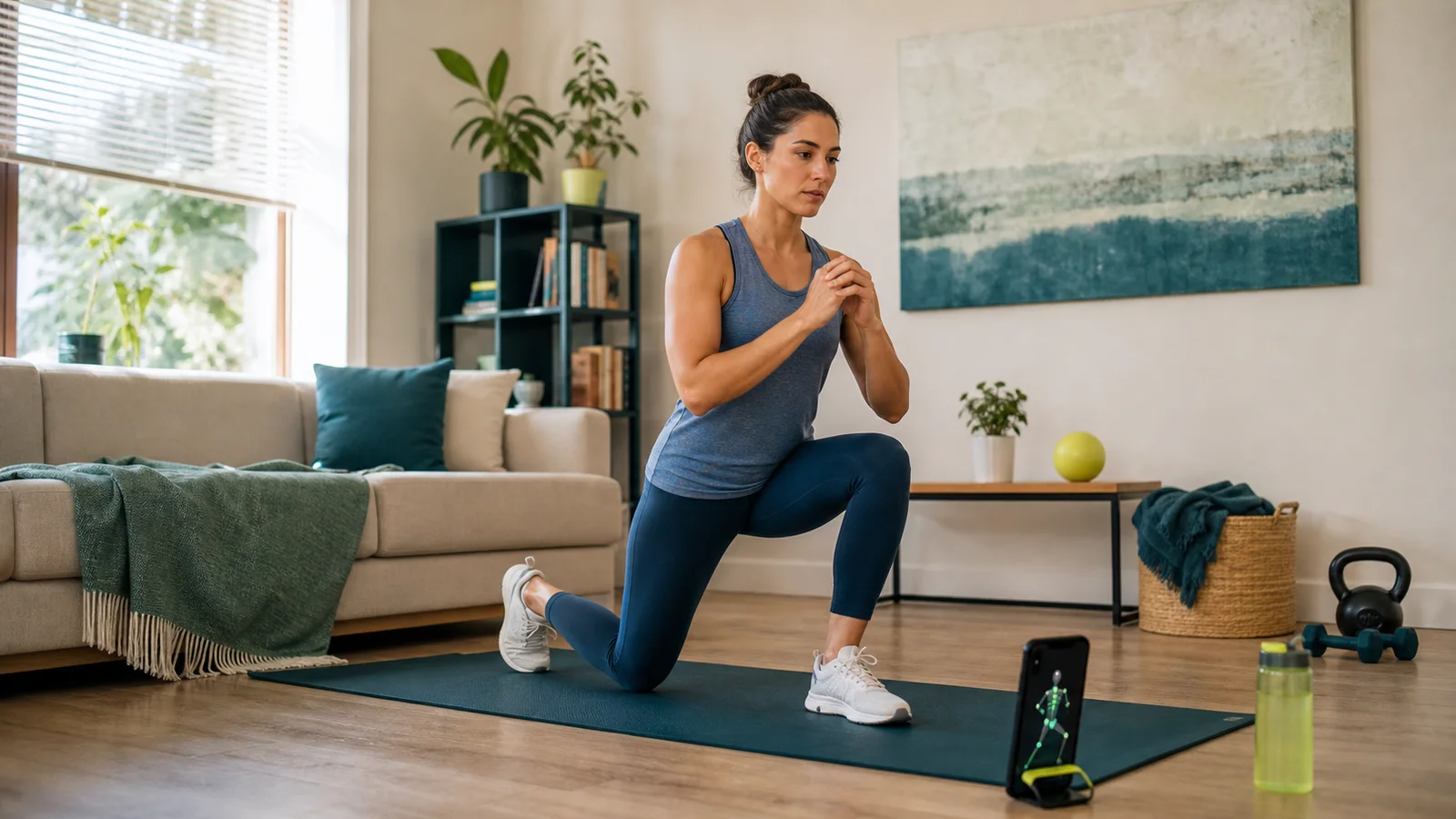
Search for the best AI fitness coach app in 2026 and you will find plenty of confident answers, because several apps have genuinely earned a place in the conversation. Adaptive programming, wearable-informed recovery guidance, and meal logging from a photo are all useful advances over a static workout PDF. What remains uneven is the part of training that happens between reps. Most AI coaches plan before the session or analyze after it. Far fewer can notice a movement change and respond with a useful spoken cue while you are still moving.
What changed in AI fitness coaching by 2026
A fitness app does not become an AI coach just because it can assemble exercises or answer a generic question. The more useful products change their recommendation when your actual training, schedule, or recovery changes—and make that adjustment understandable.
Three capabilities now separate a genuinely adaptive experience from a workout library with a new label:
- Day-level adaptation: the plan responds to completed workouts, missed sessions, feedback, or recovery rather than following only a fixed weekly calendar.
- Multiple useful inputs: workout history, wearable signals, meal photos, schedule, and stated constraints can inform the same recommendation.
- In-workout interaction: the app can respond during the activity through a spoken cue, conversational change, rep count, or form signal instead of waiting for the summary.
We reviewed current first-party product pages, support documentation, and App Store information on August 1, 2026. We compared the job each product is designed to do; we did not conduct a lab validation of its AI or movement analysis. Jamie's Fit publishes this guide and is included below, so we identify where specialist apps do more as well as where Jamie differs.
The best AI fitness coach apps in 2026, compared
There is no single winner for every goal. A strength-programming engine, a recovery wearable, a nutrition coach, and a camera-based movement coach solve different parts of the fitness problem. Start with the part of your routine where better guidance would change what you actually do.
| App | Best for | Main limitation |
|---|---|---|
| Fitbod | Adaptive gym strength programming | No nutrition coaching or camera-based form cues |
| Freeletics | Bodyweight, HIIT, and flexible at-home plans | Not a specialist lifting log for detailed barbell progression |
| Future | Accountability from a dedicated human coach | Premium human-coaching service, not an AI-first product |
| Caliber | Strength tracking with optional human coaching | Its structured plans are coach-designed rather than generated by AI |
| Vora | Training, nutrition, recovery, and voice in one app | Broad generalist; currently focused on iPhone and Apple Watch |
| SensAI | Training that adapts to wearable recovery data | Works best when it receives consistent wearable data |
| Welling | Fast photo or chat-based nutrition logging | Does not build or guide workout programs |
| WHOOP | Sleep, strain, and recovery trends | Requires a wearable membership and is not a workout planner |
| Impakt / Yogger | Camera-based rep feedback or movement analysis | Visual analysis is different from an audio-first guided session |
| Jamie's Fit | Movement-aware spoken coaching during varied home workouts | No meal logging or wearable recovery score |
Fitbod: best for adaptive strength programming
Fitbod remains one of the clearest choices for people who want an app to decide what to lift next. It uses your goals, available equipment, training history, and estimated muscle recovery to generate a gym session, then updates later recommendations from the work you log.
That focus is also the boundary. Fitbod is strongest as a programming and logging engine. It is not a nutrition coach, and it does not watch a squat or press through the phone camera and speak a form correction during the rep. Choose it when exercise selection, load progression, and gym structure are the main jobs you need solved.
Freeletics: best for bodyweight and HIIT flexibility
Freeletics built its reputation on equipment-light bodyweight training, short conditioning sessions, and an AI Coach that adapts a plan from your goals and feedback. Its current range also extends beyond bodyweight-only work, but the experience still makes the most sense for flexible home training, calisthenics, HIIT, and people who want a structured session without designing one.
Dedicated lifters may prefer a deeper strength log when exact set history, equipment-specific progression, and barbell programming matter most. For training in a living room, park, or travel schedule, Freeletics remains a mature, practical option.
Future and Caliber: best when a human is part of the answer
Future is not a pure AI coach, and that is the point. It matches you with a real remote coach who creates personalized workouts and provides accountability. If another person noticing your missed sessions is what keeps you consistent, software-only personalization may be solving the wrong problem.
Caliber is a useful middle ground for strength training. Its free app supports personalized workout creation, tracking, exercise tutorials, and groups. Caliber Plus adds coach-designed plans, while Premium Coaching adds a human trainer. The current product should not be described as an AI-generated strength coach; it belongs here as a benchmark for data-supported training with an optional person in the loop.
Vora: best all-in-one option with a useful free tier
Vora makes the strongest case for breadth. It brings workout programming, photo and barcode nutrition logging, wearable-informed recovery, meditation, cycle tracking, and voice interaction into one coaching layer. Its free tier includes enough of the core experience to understand whether that all-in-one approach works for you before paying for higher limits and advanced tools.
Vora also shows why “real-time voice” needs a precise definition. You can talk to it, log work, and ask for changes hands-free. That is useful in-workout interaction. It is different, however, from a camera recognizing that your movement has changed and initiating a spoken form cue from what it sees. Choose Vora when connecting several areas of health matters more than going deepest in any one of them.
SensAI: best for wearable-driven recovery adaptation
SensAI is built around the question many fixed plans ignore: how ready are you for the workout on today’s calendar? It uses signals such as HRV, sleep, resting heart rate, schedule, equipment, and completed load to shape training. Its workout tracker supports mid-session swaps and conversational modifications as conditions change.
The tradeoff is input quality. SensAI can still organize training, but its main advantage appears when a compatible wearable supplies regular recovery data. It is a strong fit for someone who already tracks sleep and readiness and wants those numbers to change the session rather than sit in a separate dashboard.
Welling: best for AI nutrition coaching
Welling treats nutrition as the product rather than a tab added to a workout app. You can describe a meal or send a photo, receive an estimate for calories and macros, and ask the coach questions based on the food you have logged and the goals you set.
Photo-based portion estimates are still estimates, especially for mixed dishes, oils, sauces, and ingredients hidden from the camera. Welling reduces the friction of logging; it does not remove the uncertainty. Choose it when food awareness and regular macro tracking are the habits you need help sustaining, not when you need a strength program.
WHOOP: best standalone recovery tracker
WHOOP is a wearable and membership rather than a conventional workout app, but it belongs in this comparison because its Recovery, Strain, and Sleep metrics influence how many people train. WHOOP calculates a daily Recovery score from overnight signals and provides a Strain target that changes with readiness and accumulated exertion.
It can help you decide whether to push, maintain, or prioritize recovery. It does not replace a detailed exercise program or observe your movement technique. Choose WHOOP when the question is how much stress your body appears ready to handle, then pair it with the training tool that tells you what to do.
Impakt and Yogger: camera-based feedback from two angles
Impakt uses a phone camera to recognize exercises, count repetitions, and provide real-time feedback inside a social, gamified fitness experience. That makes it one of the closer comparisons to movement-aware coaching, although its interface and feedback model remain screen-centered.
Yogger serves a different audience. It gives physical therapists, coaches, trainers, and other movement professionals video analysis, joint tracking, angle measurements, guided assessments, and reporting. It can make technique and progress easier to explain, but it is not primarily a consumer workout coach guiding a flowing home session from start to finish.
The gap: movement-aware coaching during the rep
Line up the products above and the category separates into layers. Fitbod and Freeletics are strongest at programming. Future and Caliber add human accountability. SensAI, Vora, and WHOOP use recovery context. Welling handles food. Impakt and Yogger can see movement, while Vora and SensAI let you speak or modify a session as it happens.
The narrower gap is the moment when your chest drops in a push-up, your knee drifts through a lunge, or your range changes as fatigue arrives. A good in-person trainer notices the movement and says something immediately. The useful digital version must connect three steps: see the body, interpret the change, and deliver a cue without making you stop to type or inspect a diagram.
That is the problem Jamie's Fit is designed around. Jamie uses the device's frontal camera to reconstruct movement and provide spoken guidance while you train. The experience spans strength, HIIT, yoga, Pilates, mobility, kickboxing, meditation, and family-friendly workouts. It does not log meals or calculate wearable recovery, so pairing it with a nutrition or recovery specialist can still make sense. Its distinct job is helping the workout respond to the movement happening now.
No consumer camera can diagnose pain or guarantee perfect technique. Movement-aware cues are general workout guidance, not a medical assessment or a substitute for a skilled trainer who understands your history.
How to choose the right app for your goal
Choose the tool around the moment where your current routine breaks down. If you repeatedly arrive at the gym without a plan, buy planning. If fatigue and sleep make fixed programs unreliable, buy recovery context. If food logging never lasts, reduce the logging friction. If you know the workout but lose form or focus while doing it, prioritize in-session guidance.
- For adaptive gym strength programming: Fitbod.
- For bodyweight, HIIT, and travel-friendly training: Freeletics.
- For accountability from a real person: Future, or Caliber Premium Coaching for a strength-focused option.
- For one app spanning workouts, nutrition, recovery, and voice interaction: Vora.
- For training that changes with wearable recovery signals: SensAI.
- For faster photo or chat-based nutrition logging: Welling.
- For a dedicated view of sleep, strain, and recovery: WHOOP.
- For professional movement analysis or visual rep feedback: Yogger or Impakt.
- For movement-aware spoken guidance across varied home workouts: Jamie's Fit.
Frequently asked questions
Is an AI fitness coach as good as a human trainer?
Not in every dimension. An app can be available at any time, remember logged data, and make consistent rule-based or model-assisted adjustments. A skilled human can understand more context, observe details outside a camera frame, build a relationship, and make nuanced judgments. Future and Caliber Premium Coaching keep a human in the loop; other apps trade some of that judgment for lower cost and constant access.
Do I need a wearable to use an AI fitness coach?
No. Fitbod, Freeletics, Caliber, Welling, Impakt, Yogger, and Jamie's Fit can provide their main experience without a recovery wearable. SensAI and Vora gain more context from wearable data, while WHOOP is itself a wearable service.
What makes camera-based AI coaching different from a workout video?
A workout video plays the same way regardless of what you do. A camera-based feature analyzes movement captured by your device and may count reps, estimate positions, or trigger feedback. Accuracy can change with lighting, camera angle, clothing, visibility, and the exercise, so the output should be treated as guidance rather than a clinical assessment.
Can one app cover training, nutrition, and recovery well?
Vora is designed around that all-in-one goal. Specialist apps usually go deeper in one layer: Fitbod in gym programming, Welling in nutrition, WHOOP in recovery, or Jamie in movement-aware spoken workout guidance. One broad app is simpler; a small stack can be more specialized.
What is the best free AI fitness coach app?
The best free option depends on which features remain available without upgrading. Vora offers a useful free tier across several coaching areas, while Caliber provides a strong free strength tracker but is not an AI-first coach. Free limits and subscription terms can change, so confirm the current App Store listing before building your routine around one feature.
AI fitness coaches provide general training or wellness guidance, not medical care. Stop if a movement causes sharp or increasing pain, chest pain, faintness, or unusual shortness of breath. Ask a qualified professional before starting or changing a program when you have an injury, health condition, pregnancy, or another reason exercise may need to be modified.
Sources
Product capabilities and access terms can change. These first-party pages were checked on August 1, 2026; confirm current availability in the relevant app store before subscribing.
- Fitbod: How the personalized workout algorithm works
- Freeletics: AI bodyweight training and personalized plans
- Future: Coach matching and personalized accountability
- Caliber App Store listing: Free, Plus, and Premium Coaching features
- Vora: Workouts, nutrition, recovery, integrations, and voice coaching
- SensAI: Smart planning, workout tracking, and recovery features
- Welling: AI photo logging and nutrition coaching
- WHOOP Support: How Recovery is calculated
- Impakt: Camera-based movement tracking and real-time feedback
- Yogger: Video analysis and AI movement assessments
- Jamie's Fit: Real-time movement reconstruction and spoken coaching