
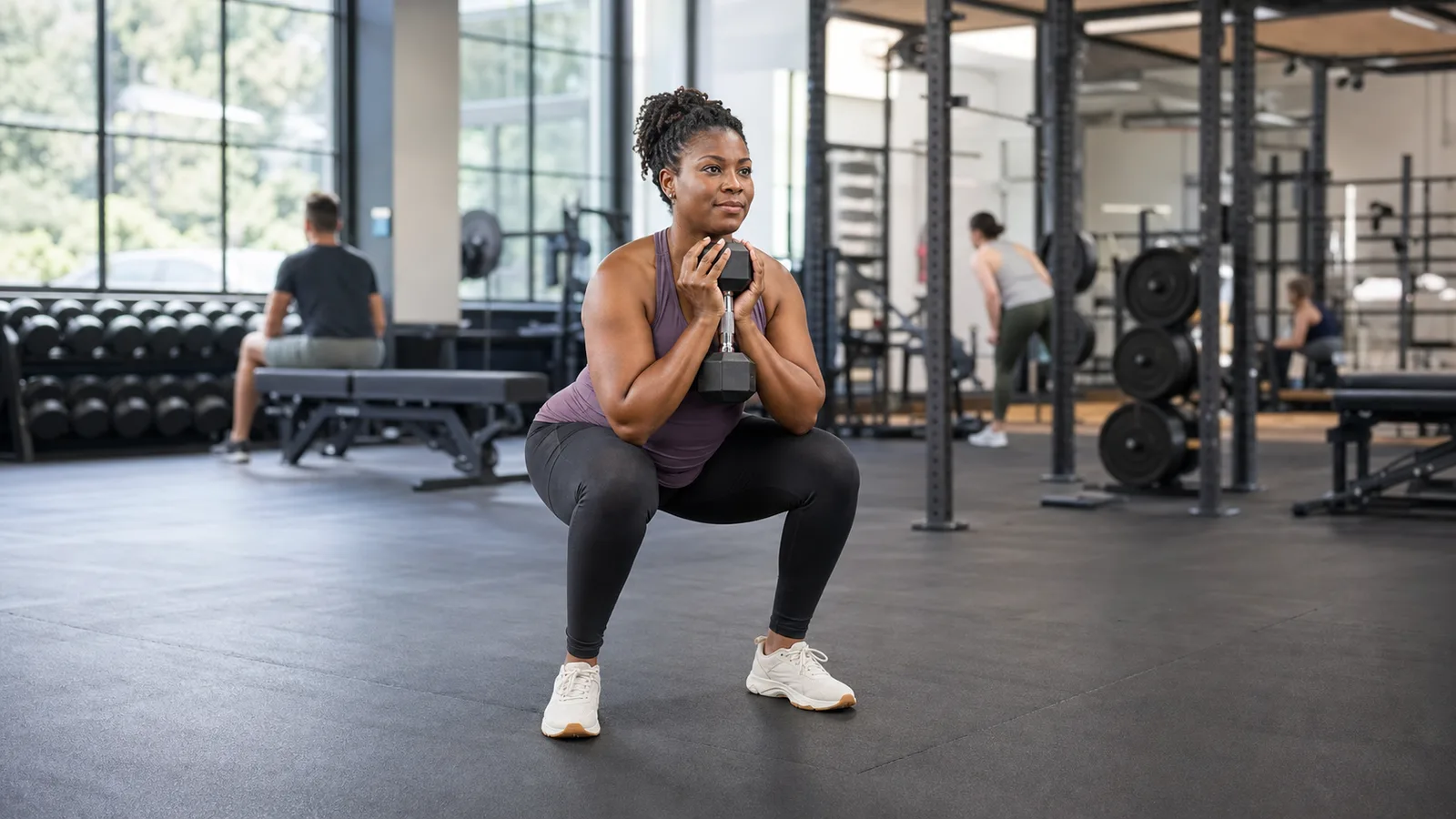
A beginner gym workout plan for women does not need special “toning” exercises or a different set of training rules. Women build strength and muscle through progressive resistance training, just as men do. The useful differences are personal: your goals, experience, equipment, schedule, health, and which movements feel comfortable.
Your three-day beginner gym schedule
Train on three nonconsecutive days, such as Monday, Wednesday, and Friday. Each workout uses a squat or single-leg movement, a hip-focused movement, a push, a pull, and a small amount of core work. Start with two work sets during the first two weeks; add a third set only when you are recovering well.
The plan is full-body because frequent practice helps beginners learn gym movements. A systematic review found that resistance training produces substantial strength gains and measurable hypertrophy in healthy adult women.
| Day 1 | Day 2 | Day 3 | Sets × reps |
|---|---|---|---|
| Goblet squat | Leg press | Split squat | 2–3 × 8–12 |
| Dumbbell Romanian deadlift | Seated leg curl | Hip thrust | 2–3 × 8–12 |
| Machine chest press | Dumbbell overhead press | Incline push-up | 2–3 × 8–12 |
| Seated cable row | Lat pulldown | One-arm cable row | 2–3 × 8–12 |
| Dead bug | Farmer carry | Side plank from knees | 2 rounds |
How much weight should a beginner use?
Choose a load you can move through a comfortable range while keeping the last two repetitions challenging but controlled. There is no correct starting dumbbell for all women. An exercise for the legs may use far more weight than a shoulder exercise, and machines vary between gyms.
During your first session, err on the light side. If you could perform many more repetitions, increase the next set slightly. If form changes before the bottom of the range, reduce the load or use an easier variation.
Warm up without turning it into another workout
Begin with five minutes of comfortable movement, then rehearse the first exercise with a lighter load. Add one or two gradual warm-up sets before a demanding press or lower-body movement. You do not need a long sequence of stretches before every session.
A warm-up should make you feel prepared. It should not create fatigue that reduces the quality of your work sets.
Progress the plan for eight weeks
Record each load and repetition. When you reach the top of the target range for every set with steady technique, increase the load by the smallest available amount. If the next jump is large, keep the same load and add repetitions more slowly.
Keep the exercise menu mostly stable for six to eight weeks. Change a movement when it causes pain, does not fit your equipment, or stays awkward after coaching—not because a new routine appeared on social media.
Symptoms and preferences vary. Adjust a session when you need to, but there is no universal cycle-based program every woman must follow.
Recovery, cardio, and common goals
Walking, cycling, or other cardio can fit on easier days or after lifting. Keep the total amount realistic so you can recover for the next strength session. Fat loss requires a sustainable energy deficit; muscle gain is supported by enough training, protein, and total food. “Toning” is simply a visual description, not a special physiological process.
Pregnancy, recent childbirth, pelvic-floor symptoms, low energy availability, an injury, or a health condition can change what is appropriate. Seek individualized care instead of relying on a generic women’s workout.
Frequently asked questions
How many days should a beginner woman go to the gym?
Two or three nonconsecutive strength days are a practical start. Choose the frequency you can repeat and recover from before adding more sessions.
Will lifting weights make women bulky?
Resistance training can build muscle, but large changes require sustained training, nutrition, recovery, and time. The program and total workload determine the stimulus; lifting does not cause an instant or accidental transformation.
Should women do different exercises from men?
Not by default. Exercise choice should reflect goals, anatomy, comfort, experience, health, and equipment rather than stereotypes.
This article provides general fitness information, not individual medical advice. Choose movements suitable for your ability and speak with a qualified professional when you have pain, an injury, or a health concern.
Sources
Jamie’s Fit uses authoritative health guidance to review general exercise recommendations.